

A golden leaf hanging from a tree might not be a leaf at all. In Roco Kingdom, Folbit is a tiny Jini that disguises itself among foliage, remaining almost perfectly still until the wind carries it away. It evolves into Follet and eventually Folorb, a fast Common / Bug-class Jini that specializes in magical attacks. All three stages share Resonance, a trait that increases the Power of Insect Hum by 20. Combined with Insect Hum's lineup-based Combo Count mechanic, this evolution line offers an unusual strategy built around coordinated multi-hit attacks. Here is how each stage evolves, how their stats improve and how to build around Resonance.
The evolution line
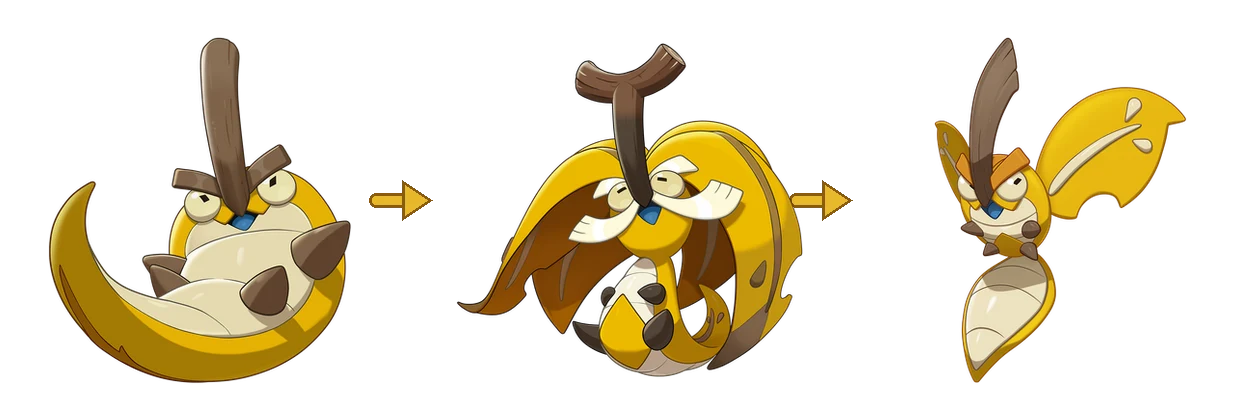
Folbit evolves into Follet at Level 25, while Follet evolves into Folorb at Level 35.
All three stages belong to the Common and Bug classes. This guide covers the Golden Variant shown in the screenshots.
- Folbit (No. 118, Common / Bug): A tiny, leaf-like Jini that spends much of its time hanging from trees. Folbit is remarkably good at camouflage, with a body that imitates the color, shape, veins and stems of real leaves. Even its damaged-looking edges appear realistic. During the day, it usually remains completely still, swaying gently when the wind blows to avoid attracting attention.
- Follet (No. 119, Common / Bug): As Folbit evolves, its leaf-like body develops larger wing covers that allow it to glide between trees. Follet can travel short distances through the air and is frequently carried along by the wind. After landing, it may remain motionless for some time before realizing that its surroundings have changed.
- Folorb (No. 120, Common / Bug): The final evolution develops large, curved leaf-like structures surrounding its body, creating a rounded appearance. Folorb travels by allowing the wind to carry it from place to place, coming to rest when it reaches water or moist ground. As it rolls across the environment, it helps spread plant seeds. Despite its unusual appearance, Folorb is gentle and particularly protective of young Jinies, earning the friendship of many other species.
The evolution line gradually transforms from a tiny leaf mimic into a larger, wind-traveling Jini with more developed wing structures.
All three stages retain their Common / Bug classification and Resonance trait.
They also belong to the Insect and Plant Egg Groups.
A separate Dried Leaves Variant also exists, with slightly different Species Aptitude values. The stats below refer specifically to the Golden Variant.
Trait: Resonance
Increases the Skill Power of Insect Hum by 20.
All three stages share this trait. Resonance is a specialized ability that strengthens one particular skill rather than providing a general increase to Attack, Defense or Speed.
The skill affected by Resonance is Insect Hum, a Bug-class magic attack.
Insect Hum has the following properties:
- Class: Bug
- Attack type: Magic
- Base Power: 15
- Energy Cost: 2
- Effect: For every Insect Hum equipped by Jinies in the lineup, this skill gains 1 additional Combo Count.
Resonance increases Insect Hum's base Power from 15 to 35.
This is a flat increase of 20 Skill Power, not a 20% damage bonus.
Although the original Power of Insect Hum is relatively low, its ability to gain additional Combo Count makes it more interesting than a standard magic attack.
The number of Insect Hum skills equipped across the lineup determines the additional Combo Count.
For example:
- One Jini equips Insect Hum: The skill gains 1 additional Combo Count.
- Two Jinies equip Insect Hum: The skill gains 2 additional Combo Count.
- Three Jinies equip Insect Hum: The skill gains 3 additional Combo Count.
The skill's final hit count depends on its underlying Combo mechanics and any additional effects.
Resonance does not directly increase the number of hits. Instead, it increases the Skill Power of Insect Hum, while the skill's own effect increases Combo Count.
This makes the two mechanics complementary.
The main advantage is that Folorb can benefit from a stronger Insect Hum while its teammates help increase the skill's Combo Count through their equipped movesets.
However, the strategy requires team preparation.
A Folorb equipped with Insect Hum will gain less Combo Count support if the rest of the lineup does not carry the same skill.
Likewise, Resonance only strengthens Insect Hum and does not automatically increase the Power of other Bug-class attacks.
For players interested in building a team around multi-hit magic skills, Resonance gives this evolution line a distinct tactical identity.
Stats at every stage
Here is how Species Aptitude grows throughout the evolution line:
- Folbit, 326 total: HP 56, Physical Attack 15, Magic Attack 65, Physical Defense 63, Magic Defense 55, Speed 72
- Follet, 433 total: HP 74, Physical Attack 19, Magic Attack 87, Physical Defense 84, Magic Defense 73, Speed 96
- Folorb, 542 total: HP 93, Physical Attack 24, Magic Attack 109, Physical Defense 105, Magic Defense 91, Speed 120
Folbit's total Species Aptitude increases from 326 to 433 after evolving into Follet, then reaches 542 in its final form.
That represents an overall improvement of 216 points.
Speed is the strongest stat throughout the entire evolution line.
Folbit begins with 72 Speed, Follet reaches 96, and Folorb eventually gains 120.
This makes Folorb relatively fast and allows it to act before many slower opponents.
Magic Attack is another important strength, increasing from 65 to 109.
Although this is not an exceptionally high Magic Attack compared with dedicated magical attackers, it works well with Resonance and multi-hit skills.
Physical Defense also improves considerably, reaching 105 in Folorb.
Combined with 93 HP and 91 Magic Defense, this gives the final evolution reasonably balanced defensive capabilities.
However, Physical Attack remains extremely low.
Folbit begins with just 15 Physical Attack, and even after reaching its final evolution, Folorb has only 24.
This is one of the most noticeable weaknesses of the entire evolution line.
As a result, physical attacks are generally poor choices for Folorb compared with magic-based attacks.
Even powerful physical skills may struggle to take advantage of such a low Physical Attack stat.
Overall, Folorb is best suited to a fast magic-focused role rather than physical offense.
Its Speed and defensive stats allow it to support different strategies, but Resonance and Insect Hum provide its most distinctive offensive combination.
Size and capture details:
- Folbit: 0.1 to 0.15 m, 0.1 to 0.85 kg. Gives 16 Starlight and a 1,200 Roco Coin base review reward.
- Follet: 0.53 to 0.76 m, 0.65 to 1.68 kg. Gives 28 Starlight and a 2,100 Roco Coin base review reward.
- Folorb: 0.6 to 0.7 m, 1.45 to 3.43 kg. Gives 40 Starlight and a 3,000 Roco Coin base review reward.
Class effectiveness
Folbit, Follet and Folorb all belong to the Common and Bug classes, meaning their offensive and defensive matchups remain unchanged throughout evolution.
Folbit, Follet and Folorb (Common / Bug)
When attacking with Common skills:
- Deals ×0.5 damage to: Earth, Shadow and Mech
- Deals normal ×1 damage to: All other classes
When attacking with Bug skills:
- Deals ×2 damage to: Flora, Havoc and Stellar
- Deals ×0.5 damage to: Fire, Poison, Fighting, Wing, Charm, Shadow and Mech
When defending as Common / Bug:
- Takes ×2 damage from: Fire and Wing
- Takes ×0.5 damage from: Flora and Shadow
Unlisted matchups deal normal ×1 damage.
The Common / Bug combination provides Folorb with several useful offensive matchups.
Bug attacks are particularly effective against Flora, Havoc and Stellar.
Flora is one of the most favorable opponents because Folorb deals double damage with Bug attacks while taking only half damage from Flora skills.
Shadow also offers a useful defensive advantage, as Folorb takes only half damage from Shadow-class attacks.
However, Shadow resists both Common and Bug attacks, making it difficult for Folorb to deal strong damage using its natural classes.
Mech presents a similar offensive problem.
Both Common and Bug attacks deal only half damage to Mech opponents, so additional coverage skills may be necessary.
Fire and Wing are the two most important defensive weaknesses.
Both deal double damage to Folorb.
Fire is particularly dangerous because it also resists Bug attacks, making it difficult for Folorb to retaliate effectively with Insect Hum.
Wing opponents present another difficult matchup because they resist Bug attacks while dealing double damage to Folorb.
Although Folorb has 105 Physical Defense and 91 Magic Defense, powerful super-effective attacks can still cause serious problems.
Players should avoid relying entirely on its defensive stats and switch out when facing dangerous Fire or Wing attackers.
Research skills
Folorb has three listed research skills:
- Clamor: A Common-class Status skill costing 3 Energy. It increases the Energy Cost of all enemy attack skills by 2 for 3 turns.
- Mana Burst: A Common-class magic attack with a displayed base Power of 1 and no fixed Energy Cost. It consumes all available Energy when used, with damage increasing according to the amount consumed.
- Pursuit: A Common-class magic attack with 75 Power and an Energy Cost of 3. It normally performs a one-hit combo, but becomes a three-hit combo when successfully countering a Status skill.
These skills offer several tactical options beyond Folorb's signature Insect Hum strategy.
Clamor provides useful Energy disruption.
By increasing the Energy Cost of enemy attack skills for 3 turns, Folorb can make expensive attacks harder for opponents to use.
This is particularly useful against enemies that rely on powerful, high-cost attacks.
However, Clamor does not directly restore Energy to Folorb, so players still need to manage their own resources.
Mana Burst provides an unusual way to convert stored Energy into magical damage.
Although its displayed base Power is only 1, its damage increases based on the Energy consumed.
This allows Folorb to save Energy before attempting a stronger attack.
However, because Mana Burst consumes all available Energy, using it at the wrong moment can leave Folorb unable to afford its other skills.
Mana Burst is therefore better suited to carefully timed attacks rather than constant use.
Pursuit provides a more predictable offensive option.
It starts as a one-hit magic attack with 75 Power.
When it successfully counters a Status skill, its Combo Count increases to three hits.
This can be useful against opponents that frequently rely on Status skills for buffs, recovery or battlefield control.
Unlike Insect Hum, Pursuit does not directly benefit from Resonance.
However, its multi-hit counter effect provides an alternative offensive strategy.
Notable skills and battle strategies
Folorb has access to several other useful skills that complement its Magic Attack, Speed and Resonance trait.
Some notable options include:
- Insect Hum: A Bug-class magic attack with 15 base Power and an Energy Cost of 2. Its Combo Count increases according to how many Jinies in the lineup have Insect Hum equipped. Resonance increases its Power by 20.
- Web Trap: A Bug-class magic attack with 30 Power and no Energy Cost. It restores 1 Energy after use.
- Insect Curse: A Bug-class magic attack with 100 Power and an Energy Cost of 3. It deals direct magical damage.
- Feign Sleep: A Bug-class Status skill costing 2 Energy. It restores 2 Energy and grants the allied lineup 1 stack of Offering that reduces Energy Cost by 2.
- Lullaby: A Common-class Status skill costing 5 Energy. It increases the Energy Cost of enemy skills by 3. Successfully countering a Defense skill also interrupts and stuns the enemy for the next turn.
- Last Stand: A Common-class magic attack with 95 Power and an Energy Cost of 4. If Energy is depleted after using the skill, its Power increases by 120.
These skills support different approaches to battle.
Insect Hum remains the central option for a Resonance-focused build.
Its effectiveness depends heavily on lineup preparation.
A team containing multiple Jinies equipped with Insect Hum can provide additional Combo Count, making Folorb's signature attack more effective.
Because Folorb has 120 Speed, it may also be able to attack before many slower opponents.
However, Speed does not directly increase the damage or Combo Count of Insect Hum.
Web Trap is a useful Energy recovery option.
Since it costs no Energy and restores 1 Energy after use, Folorb can use it to recover resources between more expensive attacks.
This provides a simple way to maintain access to Insect Hum and other magic skills.
Insect Curse offers straightforward Bug-class magical damage.
With 100 base Power, it is useful when Folorb needs a stronger single attack rather than relying on Combo mechanics.
Against Flora, Havoc and Stellar opponents, its Bug-class effectiveness can make it particularly valuable.
Feign Sleep provides support for both Folorb and its teammates.
It restores Energy while granting an Offering effect that reduces Energy Cost.
This can help the team use more expensive skills without exhausting resources as quickly.
Lullaby offers another form of Energy disruption.
Increasing the Energy Cost of all enemy skills makes it more difficult for opponents to maintain their preferred battle rotation.
Its additional counter effect can also interrupt and stun opponents under the correct conditions.
However, Lullaby itself costs 5 Energy, making it a relatively expensive support skill.
Last Stand provides an interesting alternative to Mana Burst.
Its base Power is 95, but it gains an additional 120 Power if Folorb's Energy becomes depleted after casting it.
This makes it potentially useful when Folorb has just enough Energy to activate the skill.
Unlike Mana Burst, Last Stand has a fixed initial Energy Cost, so players can plan the timing more precisely.
Additional skill options
Folorb can also access several useful skills through Skill Tablets.
Warm-Up is a Common-class Status skill costing 2 Energy. It increases Combo Count by 3.
This is particularly interesting for players experimenting with multi-hit attacks.
Although Resonance specifically strengthens Insect Hum, additional Combo Count effects may create further opportunities for a Combo-focused team.
Preparation is a Common-class Status skill costing 1 Energy. It increases the Power of the next attack by 70.
This can provide a significant boost to a carefully timed magic attack.
Bloom is a Flora-class Status skill costing 1 Energy. It increases the Power of all skills by 30, or by 60 when successfully countering a Defense skill.
This offers another way to improve Folorb's offensive potential.
Root Absorb is a Flora-class Status skill costing 2 Energy. It restores 15% Health and 4 Energy.
This can help Folorb maintain resources during longer battles.
Floral Aroma is a Flora-class magic attack with 60 Power and an Energy Cost of 1.
It provides additional offensive coverage against classes vulnerable to Flora attacks.
Explosion is a Stellar-class magic attack with 100 Power and an Energy Cost of 3.
This gives Folorb another option for dealing magical damage outside its natural Common and Bug classes.
Sync Up is a Common-class magic attack with 125 Power and an Energy Cost of 3.
It provides strong direct magic damage, although it does not benefit from Resonance.
Intercept is a Common-class magic attack with 75 Power and an Energy Cost of 2. Successfully countering a Status skill allows it to interrupt the opponent's action.
This makes it useful against opponents that frequently attempt to prepare buffs or other Status effects.
Together, these skills allow Folorb to support a range of strategies.
A Resonance-focused build can prioritize Insect Hum and Energy recovery, while a more conventional magic build can use Insect Curse, Sync Up and other direct attacks.
Players interested in battlefield control can also experiment with Clamor, Lullaby and Intercept.
Battle strategy: Building an Insect Hum team
The most distinctive way to use Folorb is to build around Resonance and Insect Hum.
Unlike straightforward magical attackers, Folorb benefits from the skills equipped by other Jinies in the lineup.
This creates an opportunity to design a coordinated team rather than focusing exclusively on Folorb's individual moveset.
A practical approach follows several steps:
- Equip Insect Hum on Folorb. Resonance increases its Skill Power from 15 to 35, making it stronger than the standard version.
- Add other Jinies with Insect Hum. Each additional copy equipped across the lineup contributes to the skill's Combo Count.
- Maintain enough Energy. Insect Hum costs 2 Energy, so Web Trap or Feign Sleep can help keep Folorb active.
- Choose favorable opponents. Bug attacks deal double damage to Flora, Havoc and Stellar, making those classes attractive targets.
- Use alternative attacks when necessary. Against opponents that resist Bug, skills such as Explosion or suitable magic coverage can provide better options.
This strategy rewards lineup preparation.
For example, a team containing multiple Bug-class Jinies with Insect Hum equipped can strengthen the Combo potential of the skill without requiring Folorb to spend several turns setting up its own buffs.
However, the strategy also has limitations.
Equipping Insect Hum across multiple teammates uses skill slots that could otherwise provide defensive abilities, additional coverage or other support options.
Players should therefore balance Combo Count improvements against the overall flexibility of their team.
Another consideration is Folorb's offensive stat distribution.
With 109 Magic Attack and only 24 Physical Attack, its moveset should generally prioritize magic skills.
Although some physical Bug attacks provide useful secondary effects, they are unlikely to take advantage of Folorb's strongest stats.
Its 120 Speed provides another advantage, helping it act before slower opponents.
However, Folorb is not particularly durable against super-effective attacks, so players should avoid leaving it exposed to strong Fire or Wing attackers.
Overall, Folorb is best suited to a coordinated, magic-focused team that can take advantage of Insect Hum's Combo Count mechanic.
Alternative strategy: Energy control and magic damage
Players who do not want to build an entire team around Insect Hum can also use Folorb as a fast magic attacker with Energy-control support.
Clamor and Lullaby provide ways to increase the Energy Cost of enemy skills.
This can interfere with opponents that depend on expensive attacks or carefully planned Energy usage.
Meanwhile, Web Trap and Feign Sleep help Folorb recover Energy.
A straightforward strategy could involve using Clamor to disrupt the opponent, then attacking with Insect Curse or Sync Up.
For a more aggressive approach, Mana Burst and Last Stand provide opportunities for stronger attacks when Energy is managed carefully.
However, these approaches do not make full use of Resonance.
The trait only strengthens Insect Hum, so teams built around other attacks will receive fewer direct benefits from Folorb's signature ability.
For this reason, a dedicated Insect Hum strategy remains the most distinctive way to use this evolution line.
Specialties
All three stages share the same Specialty odds:
- None: 64%
- Ambusher: 6.9%
- Affectionate: 6.9%
- Nimble: 6.9%
- Fleetfoot: 6.9%
- Fearless: 6.9%
- Sharer: 0.48%
- Homebody: 0.48%
- Helper: 0.48%
- Merciful: 0.01%
Most Jinies in this evolution line have no Specialty, with a 64% probability.
Ambusher is useful for capturing wild Jinies by providing a guaranteed Backstab when throwing the Jini.
Affectionate improves interactions with Rocos, making it easier to build Trust through regular interaction.
Nimble increases gathering range, providing additional utility during exploration and resource collection.
Fleetfoot increases movement speed while riding, making it useful for players who use Folorb as a Ridable Jini.
Fearless provides utility in environments that would normally cause Aversion.
Sharer offers an opportunity to obtain additional materials during gathering and mining.
Homebody provides benefits related to Crafting Inspiration and Home EXP.
Helper is a rarer Specialty that can improve EXP gains for Jinies in the active lineup after winning battles or capturing wild Jinies.
Merciful is the rarest possibility at just 0.01%, allowing the Jini to leave wild opponents with 1 HP instead of defeating them with a lethal attack.

Where to start
- Evolve Folbit into Folorb. Folbit evolves into Follet at Level 25, then into Folorb at Level 35. Total Species Aptitude increases from 326 to 542, with Speed reaching 120 and Magic Attack reaching 109.
- Build around Resonance and Insect Hum. Resonance increases Insect Hum's Skill Power by 20, while additional Insect Hum copies equipped across the lineup increase its Combo Count.
- Prioritize magic attacks. Folorb has 109 Magic Attack but only 24 Physical Attack. Insect Hum, Insect Curse and other magic skills make better use of its stats than physical attacks.
- Use Energy recovery and control skills. Web Trap restores 1 Energy without an Energy Cost, while Feign Sleep restores Energy and grants an Offering. Clamor and Lullaby can increase enemy skill costs.
- Target Flora, Havoc and Stellar opponents. Bug attacks deal double damage to these classes. Avoid Fire and Wing attackers, which deal double damage to Folorb, and consider alternative coverage against Shadow and Mech opponents that resist both of its natural classes.


Comments 0
Share ideas. Be kind. Keep spoilers marked.
Sign in to share your thoughts and reply to other players.